

Why Spectral Scanning Matters at Motzfeldt
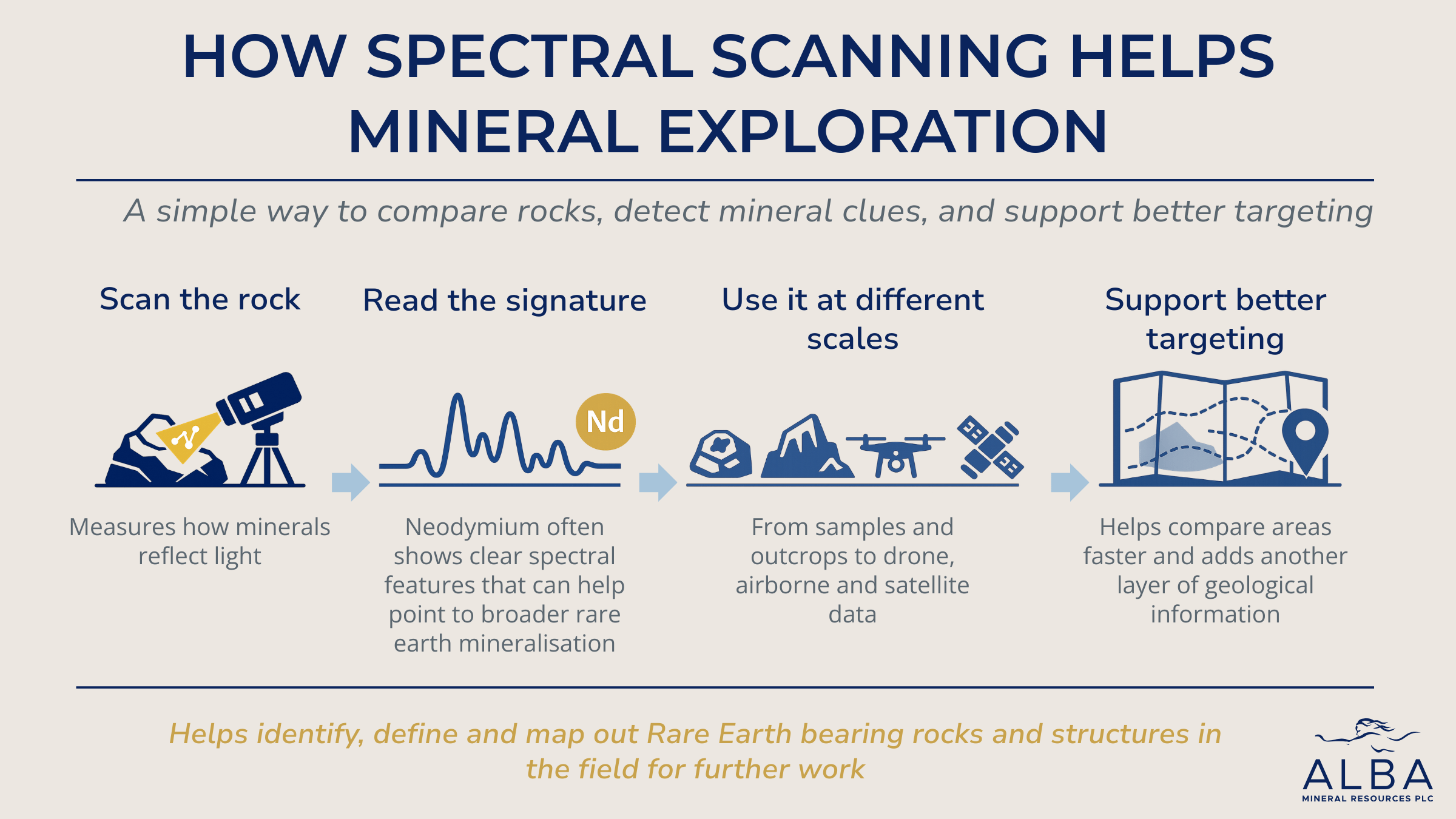
Spectral scanning and hyperspectral imaging are becoming genuinely useful tools in rare earth exploration. That is because some rare earth minerals carry distinctive spectral signatures. Neodymium, in particular, has some of the clearest absorption features, which is why it is often used as a pathfinder for broader rare earth mineralisation. Published work has shown that these signals can be detected in the right geological setting, even at relatively low concentrations.
What makes this interesting is that the technology now works across multiple scales. It is not just a lab technique. Similar approaches have been applied from hand samples and ground-based surveys through to drone, airborne and even satellite datasets, including bastnäsite-focused methods used to screen and compare targets over much larger areas.
For a project like Motzfeldt, that could be useful in a few ways: helping to compare outcrops and samples more quickly, supporting follow-up targeting, and adding another layer of geological information alongside mapping, sampling and lab work. It is not a replacement for any of those things, but it can help make the overall workflow sharper and more efficient. The same thinking applies more broadly across critical minerals projects: better screening, better targeting and better integration of data before committing to more detailed work.
Used properly, this kind of technology helps build geological understanding faster, and that is exactly where good exploration should be heading.
#AlbaMineralResources #CriticalMinerals #RareEarths #ResponsibleMining #Exploration #MiningTechnology
0
likes
•
0
questions
•
0
company answers
Ask a question
Your question will be sent privately to Alba Mineral Resources. The company may choose to make this question public.
Investor Q&As
Start the conversation
Ask Alba Mineral Resources a question about this update.